Can Artificial Intelligence Replace a Specialist Rhinoplasty Surgeon?
Can AI replace a specialist rhinoplasty surgeon? Dr Shahin Bastaninejad's study in Aesthetic Plastic Surgery compared ChatGPT, Gemini and two expert surgeons — and found the chatbots scored higher on empathy, accuracy, completeness and communication.
Dr Shahin Bastaninejad has addressed this question in his latest article published in Aesthetic Plastic Surgery: How did ChatGPT and Gemini perform in revision rhinoplasty consultations? The findings are interesting, but artificial intelligence cannot replace a doctor.
Revision rhinoplasty means undergoing a second nose operation, usually because a person is dissatisfied with the outcome of their first surgery. This type of surgery is considered one of the most difficult and complex procedures in facial plastic surgery. Patient satisfaction after rhinoplasty is generally lower than after other facial surgeries, and nearly 20% of patients seek revision surgery.
Most of these patients arrive at the clinic unhappy with the results of their previous operation and have high expectations for their next surgery. For this reason, consultations with these patients involve more than simply examining the condition of the nose. The surgeon must consider both the technical and medical aspects of the procedure and the patient’s emotional state and concerns.
This raises an important question: Can artificial intelligence help patients in such circumstances and provide useful consultations?
Dr Shahin Bastaninejad and his colleagues investigated this very question in an article published in the international journal Aesthetic Plastic Surgery.
Summary of the Research by Dr Bastaninejad and His Colleagues
To investigate this issue, the researchers designed 15 hypothetical questions, each representing a real concern that someone considering revision rhinoplasty might have.
The questions covered a wide range of topics, from dissatisfaction with the results of the first operation and nasal obstruction to disagreements between two surgeons, non-surgical treatments, potential risks and complications, recovery time, treatment costs and even legal action.
They then asked these same 15 questions of four respondents: ChatGPT, Gemini and two surgeons specialising in revision rhinoplasty, namely Dr Shahin Bastaninejad and Dr Luiz Carlos Ishida from the University of São Paulo.
In the next stage, four university-based ear, nose and throat specialists evaluated the responses. Importantly, the evaluators did not know whether each response had been generated by artificial intelligence or written by one of the surgeons.
Using a 5-point scale, they scored the responses in four categories: empathy, accuracy, completeness and communication skills.
What Were the Results?
The average scores (out of 5) were as follows:
| Respondent | Empathy | Accuracy | Completeness | Communication skills |
|---|---|---|---|---|
| ChatGPT | 3.2 | 4.0 | 4.1 | 4.0 |
| Gemini | 3.3 | 3.9 | 3.6 | 3.7 |
| Surgeon 1 | 2.6 | 3.3 | 2.9 | 3.1 |
| Surgeon 2 | 2.5 | 2.9 | 2.4 | 2.7 |
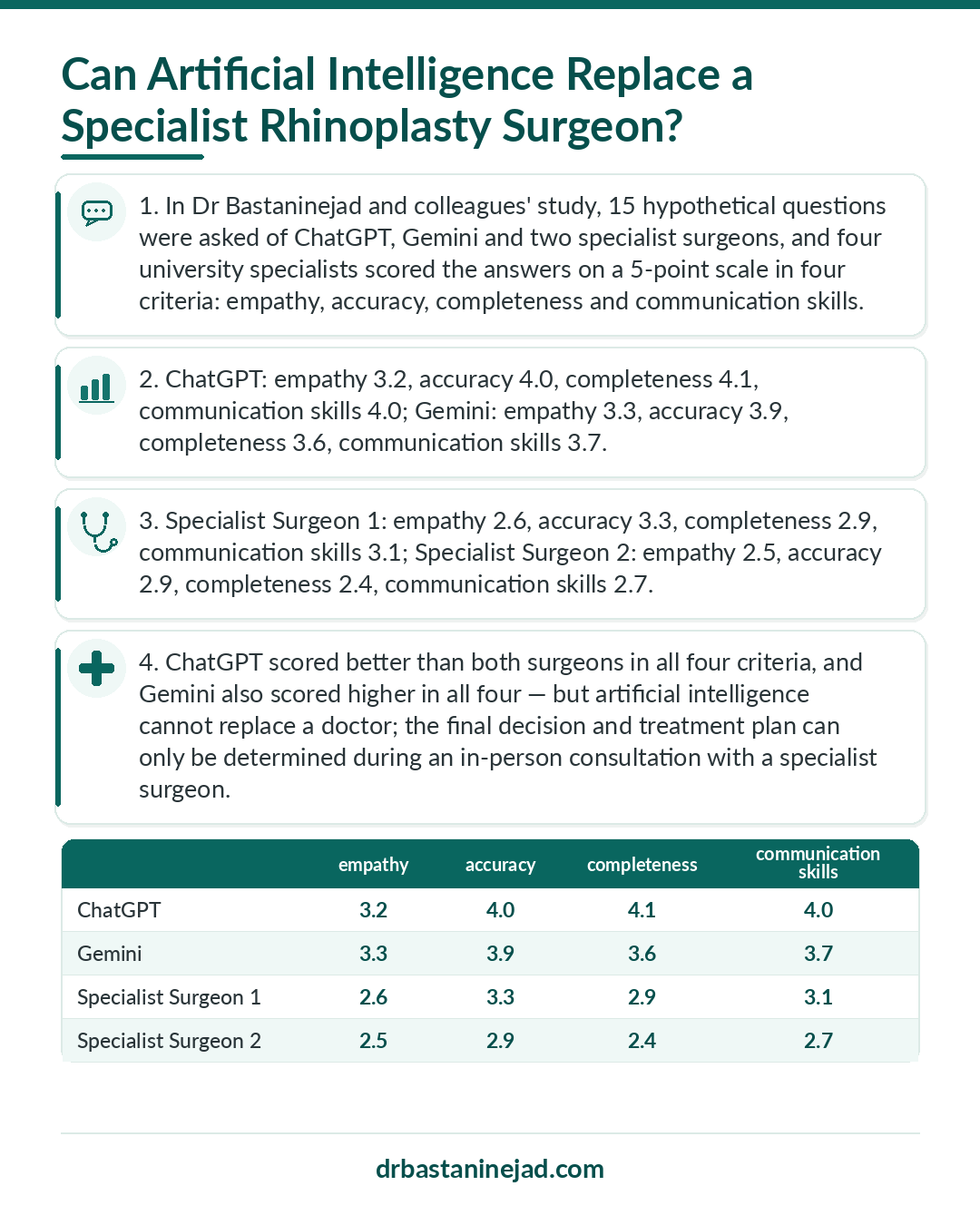
The findings were interesting. According to the study, ChatGPT performed significantly better than both surgeons across all four criteria. Gemini also received higher scores than both surgeons in all four categories.
When the researchers compared the performance of the two chatbots, they found that ChatGPT performed significantly better than Gemini only in terms of response completeness. No statistically significant differences were observed between them in the other three categories.
In the comparison between the two surgeons, Specialist Surgeon 1 performed better in terms of accuracy.
Another finding concerned the evaluators’ assessments. The four specialists who reviewed the responses agreed on three criteria: accuracy, completeness and communication skills. However, their assessments of empathy differed.
What Does This Mean?
In simple terms, the findings of this study suggest that artificial intelligence can provide patients with accurate, clear and empathetic information before they visit a doctor. However, this does not mean that artificial intelligence can replace a doctor.
The authors of the article themselves emphasised this point. The conclusion states:
In other words, ChatGPT and Gemini demonstrated impressive performance in revision rhinoplasty consultations.
However, that is not the whole story. In the continuation of the same sentence, the authors warn that chatbots have known weaknesses and may assume an uncontrolled role in facial plastic surgery and healthcare without adequate supervision.
The article also highlights several important limitations of artificial intelligence. For example, these tools sometimes provide incorrect or misleading information, occasionally use excessively technical terminology, and raise concerns regarding ethical issues and privacy protection.
Another noteworthy point is that, to date, the US Food and Drug Administration has approved nearly a thousand AI-based tools, but it has not yet approved any large language models.
Of course, this study itself also has limitations. The questions were designed based on the experiences of two of the authors, the evaluators’ scoring depended to some extent on their personal judgement, and AI models are constantly changing and improving.
So, What Are the Practical Implications of This Research for Someone Considering Revision Rhinoplasty?
If you are unhappy with the results of your previous nose surgery and are considering another operation, you can use artificial intelligence to help you prepare before visiting a doctor. For example, you can gather preliminary information about treatment options, potential complications, the recovery period or questions you should ask your surgeon.
Therefore, if you are considering revision rhinoplasty, you can use artificial intelligence to obtain information before consulting a doctor. However, remember that the final decision and treatment plan can only be determined during an in-person consultation with a specialist surgeon.
Original Source
This article, entitled “Evaluating the Insights of ChatGPT, Gemini and Expert Surgeons in Revision Rhinoplasty Consultation”, was published in Aesthetic Plastic Surgery (Springer).
Authors: Shahin Bastaninejad, Samira Alipour, Luiz Carlos Ishida, Farrokh Heidari, Habib Azimi, et al.
Full article: View the full article
References
APA · 7th edition
- Bastaninejad, S., Alipour, S., Ishida, L. C., Heidari, F., Azimi, H., et al. (2026). Evaluating the insights of ChatGPT, Gemini and expert surgeons in revision rhinoplasty consultation. Aesthetic Plastic Surgery, 50, 3831–3838. doi.org/10.1007/s00266-025-05464-w
The references in this article are formatted in APA (7th edition) style and have been verified in PubMed and Crossref.